
Need help? Text us and our team of experts will reply in minutes

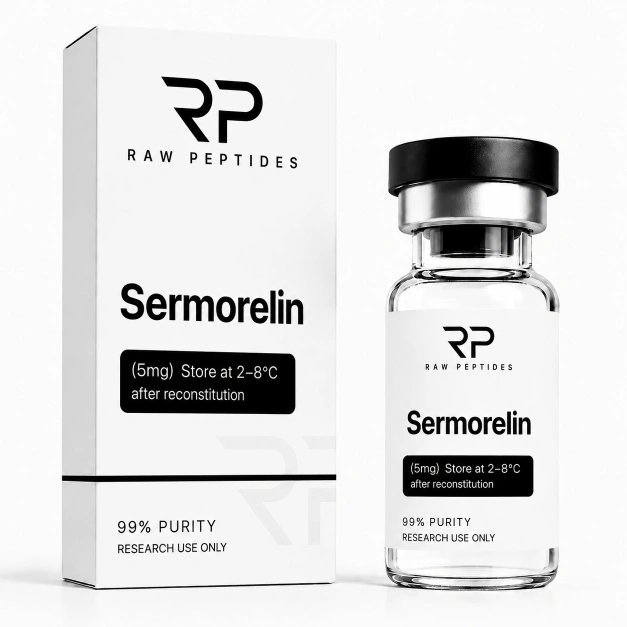
SERMORELIN

CAS #: 86168-78-7

SERMORELIN

Research Use Only

All products are intended solely for laboratory research and are not for human or animal consumption. By purchasing, the buyer agrees to use these products in compliance with all applicable laws.

Sermorelin Overview

Sermorelin is a synthetic peptide analog of GHRH (1-29). It is studied in laboratory and preclinical models for its ability to modulate somatotroph axis signaling, thereby influencing downstream cascades and associated pathway activity. Research has focused on its role in endocrine modulation, molecular dynamics, and structural remodeling processes.

Walker R.F. et al. (1994).

History

Sermorelin was developed in the late 20th century as a stabilized fragment of GHRH (1-29), the biologically active portion of the endogenous peptide. Initial investigations focused on its pharmacokinetics and ability to activate pituitary signaling pathways. Since then, it has been used widely in experimental models to study endocrine dynamics, pathway activity, and age-associated changes in somatotroph axis signaling.

Walker R.F., Risher W.H. et al. (1994).

Sermorelin Structure

CAS #: 86168-78-7

Molecular Formula: C₁₄₉H₂₄₆N₄₄O₄₂S

Molecular Weight: 3357.9 g/mol

PubChem ID: 16132308

Research Findings

Sermorelin has been investigated in endocrine, signaling, and experimental models, with research focusing on its ability to modulate somatotroph axis activity, influence downstream cascades, and support structural remodeling mechanisms. Studies also highlight its role in pathway characterization, molecular proliferation, and signaling dynamics in preclinical settings.

Key Areas of Research:

  • Endocrine: Somatotroph axis, signaling, cascades

  • Signaling: Lipid pathways, dynamics, markers

  • Molecular: Proliferation, remodeling, protein synthesis

Together, these findings suggest experimental utility for Sermorelin across multiple biological systems. By engaging endocrine signaling pathways and influencing downstream and remodeling processes, Sermorelin provides a platform for research into molecular dynamics, pathway characterization, and endocrine biology in laboratory settings.

Walker R.F. et al., 1994

Our Process

STEP 1

Precision Lyophilization

Manufactured in a controlled U.S. facility under strict compounding standards.

STEP 2

Verified Purity

Every batch third-party tested with HPLC and mass spectrometry.

STEP 3

Same-Day Fulfillment

Orders dispatched same-day from our U.S. facility.
Text us, our dedicated team is here to help
Orders dispatched same-day from our U.S. facility.
Frequently Asked Questions

Orders dispatched same-day from our U.S. facility.

Each vial contains exactly what’s shown on the label. For example, a 10mg vial has exactly 10mg of lyophilized peptide. Researchers can divide it into smaller portions—like four 2.5mg measurements—but the total amount remains 10mg.

Peptides are supplied as lyophilized powder. They do not come reconstituted, and any extra supplies must be sourced separately for research applications.
In lyophilized powder form, peptides stay stable for up to 2 years. After reconstitution, it should be refrigerated and is generally stable for up to 2 months.

Products from Raw Peptides do not include usage instructions, as they are strictly for in vitro research and prohibited by law for human or animal use. Misuse or unlawful application will result in permanent denial of service.

Lyophilized peptides should be stored away from heat and light. Once reconstituted, they must be refrigerated to maintain stability and efficacy.